Arduino - How to Read Uploaded Program
  | |
 Arduino Uno SMD R3 | |
| Developer | arduino.cc |
|---|---|
| Manufacturer | Arduino |
| Type | Unmarried-board microcontroller |
| Operating system | None (default) / Xinu |
| CPU |
|
| Memory | SRAM |
| Storage | Wink, EEPROM |
| Website | arduino.cc |
Arduino () is an open up-source hardware and software company, project, and user community that designs and manufactures unmarried-board microcontrollers and microcontroller kits for building digital devices. Its hardware products are licensed under a CC By-SA license, while software is licensed under the GNU Lesser General Public License (LGPL) or the GNU Full general Public License (GPL),[1] permitting the manufacture of Arduino boards and software distribution by anyone. Arduino boards are available commercially from the official website or through authorized distributors.
Arduino board designs use a multifariousness of microprocessors and controllers. The boards are equipped with sets of digital and analog input/output (I/O) pins that may be interfaced to diverse expansion boards ('shields') or breadboards (for prototyping) and other circuits. The boards feature serial communications interfaces, including Universal Series Bus (USB) on some models, which are as well used for loading programs. The microcontrollers tin can be programmed using the C and C++ programming languages, using a standard API which is also known as the Arduino language, inspired by the Processing language and used with a modified version of the Processing IDE. In addition to using traditional compiler toolchains, the Arduino project provides an integrated development environment (IDE) and a command line tool adult in Go.
The Arduino project began in 2005 every bit a tool for students at the Interaction Design Constitute Ivrea, Italy,[ii] aiming to provide a low-cost and easy manner for novices and professionals to create devices that collaborate with their environment using sensors and actuators. Mutual examples of such devices intended for beginner hobbyists include elementary robots, thermostats and motility detectors.
The proper name Arduino comes from a bar in Ivrea, Italy, where some of the founders of the project used to come across. The bar was named after Arduin of Ivrea, who was the margrave of the March of Ivrea and King of Italian republic from 1002 to 1014.[3]
History [edit]
Founding [edit]

The offset Arduino ever fabricated
The Arduino project was started at the Interaction Pattern Constitute Ivrea (IDII) in Ivrea, Italy.[2] At that time, the students used a Bones Stamp microcontroller at a price of $fifty. In 2003 Hernando Barragán created the development platform Wiring as a Master'due south thesis project at IDII, under the supervision of Massimo Banzi and Casey Reas. Casey Reas is known for co-creating, with Ben Fry, the Processing evolution platform. The project goal was to create unproblematic, low cost tools for creating digital projects by non-engineers. The Wiring platform consisted of a printed circuit board (PCB) with an ATmega128 microcontroller, an IDE based on Processing and library functions to hands program the microcontroller.[iv] In 2005, Massimo Banzi, with David Mellis, another IDII pupil, and David Cuartielles, extended Wiring by calculation support for the cheaper ATmega8 microcontroller. The new project, forked from Wiring, was called Arduino.[4]
The initial Arduino core team consisted of Massimo Banzi, David Cuartielles, Tom Igoe, Gianluca Martino, and David Mellis.[two]
Post-obit the completion of the platform, lighter and less expensive versions were distributed in the open-source community. Information technology was estimated in mid-2011 that over 300,000 official Arduinos had been commercially produced,[v] and in 2013 that 700,000 official boards were in users' hands.[6]
Trademark dispute [edit]
In early on 2008, the five co-founders of the Arduino project created a company, Arduino LLC,[7] to agree the trademarks associated with Arduino. The manufacture and sale of the boards was to be done by external companies, and Arduino LLC would get a royalty from them. The founding bylaws of Arduino LLC specified that each of the five founders transfer ownership of the Arduino brand to the newly formed company.[ citation needed ]
At the terminate of 2008, Gianluca Martino'southward visitor, Smart Projects, registered the Arduino trademark in Italy and kept this a secret from the other co-founders for about two years. This was revealed when the Arduino company tried to register the trademark in other areas of the world (they originally registered simply in the US), and discovered that information technology was already registered in Italian republic. Negotiations with Martino and his firm to bring the trademark nether control of the original Arduino company failed. In 2014, Smart Projects began refusing to pay royalties. They then appointed a new CEO, Federico Musto, who renamed the visitor Arduino SRL and created the website arduino.org, copying the graphics and layout of the original arduino.cc. This resulted in a rift in the Arduino development squad.[8] [9] [10]
In January 2015, Arduino LLC filed a lawsuit against Arduino SRL.[11]
In May 2015, Arduino LLC created the worldwide trademark Genuino, used as brand name outside the U.s.a..[12]
At the World Maker Faire in New York on 1 Oct 2016, Arduino LLC co-founder and CEO Massimo Banzi and Arduino SRL CEO Federico Musto announced the merger of the two companies.[13] Around that same fourth dimension, Massimo Banzi announced that in improver to the company a new Arduino Foundation would exist launched every bit "a new offset for Arduino", just this conclusion was withdrawn later.[14] [15]
In April 2017, Wired reported that Musto had "fabricated his bookish record... On his visitor's website, personal LinkedIn accounts, and even on Italian business documents, Musto was, until recently, listed equally holding a PhD from the Massachusetts Constitute of Applied science. In some cases, his biography also claimed an MBA from New York University." Wired reported that neither academy had any record of Musto'due south attendance, and Musto later admitted in an interview with Wired that he had never earned those degrees.[16] The controversy surrounding Musto continued when, in July 2017, he reportedly pulled many open source licenses, schematics, and code from the Arduino website, prompting scrutiny and outcry.[17]
By 2017 Arduino AG owned many Arduino trademarks. In July 2017 BCMI, founded by Massimo Banzi, David Cuartielles, David Mellis and Tom Igoe, acquired Arduino AG and all the Arduino trademarks. Fabio Violante is the new CEO replacing Federico Musto, who no longer works for Arduino AG.[xviii] [19]
Mail-dispute [edit]
In October 2017, Arduino announced its partnership with ARM Holdings (ARM). The announcement said, in part, "ARM recognized independence as a core value of Arduino ... without any lock-in with the ARM compages". Arduino intends to continue to piece of work with all technology vendors and architectures.[twenty]
Under Violante's guidance, the company started growing over again and releasing new designs. The Genuino trademark was dismissed and all products were branded once again with the Arduino name. Equally of February 2020, the Arduino community included nigh thirty million agile users based on the IDE downloads.[21]
In Baronial 2018, Arduino announced its new open source command line tool (arduino-cli), which tin can exist used as a replacement of the IDE to plan the boards from a shell.[22]
In February 2019, Arduino announced its IoT Deject service as an extension of the Create online environment.[23]
Hardware [edit]

Arduino-compatible R3 Uno lath made in Red china with no Arduino logo, but with identical markings, including "Fabricated in Italy" text
Arduino is open-source hardware. The hardware reference designs are distributed under a Creative Commons Attribution Share-Alike ii.five license and are available on the Arduino website. Layout and production files[24] for some versions of the hardware are also available.
Although the hardware and software designs are freely bachelor under copyleft licenses, the developers have requested the proper name Arduino to be exclusive to the official production and non exist used for derived works without permission. The official policy document on use of the Arduino name emphasizes that the project is open to incorporating work by others into the official production.[25] Several Arduino-uniform products commercially released have avoided the projection name by using various names catastrophe in -duino.[26]

An early Arduino board[27] with an RS-232 serial interface (upper left) and an Atmel ATmega8 microcontroller chip (black, lower correct); the 14 digital I/O pins are at the top, the 6 analog input pins at the lower correct, and the ability connector at the lower left.
Most Arduino boards consist of an Atmel 8-scrap AVR microcontroller (ATmega8,[28] ATmega168, ATmega328, ATmega1280, or ATmega2560) with varying amounts of flash memory, pins, and features.[29] The 32-chip Arduino Due, based on the Atmel SAM3X8E was introduced in 2012.[xxx] The boards use unmarried or double-row pins or female headers that facilitate connections for programming and incorporation into other circuits. These may connect with addition modules termed shields. Multiple and peradventure stacked shields may be individually addressable via an I2C series bus. Well-nigh boards include a v V linear regulator and a 16 MHz crystal oscillator or ceramic resonator. Some designs, such equally the LilyPad,[31] run at 8 MHz and dispense with the onboard voltage regulator due to specific grade-factor restrictions.
Arduino microcontrollers are pre-programmed with a boot loader that simplifies uploading of programs to the on-chip wink retentiveness. The default bootloader of the Arduino Uno is the Optiboot bootloader.[32] Boards are loaded with program code via a serial connection to another computer. Some serial Arduino boards contain a level shifter excursion to convert between RS-232 logic levels and transistor–transistor logic (TTL) level signals. Current Arduino boards are programmed via Universal Serial Bus (USB), implemented using USB-to-serial adapter chips such every bit the FTDI FT232. Some boards, such as subsequently-model Uno boards, substitute the FTDI bit with a separate AVR chip containing USB-to-series firmware, which is reprogrammable via its own ICSP header. Other variants, such equally the Arduino Mini and the unofficial Boarduino, use a detachable USB-to-serial adapter lath or cable, Bluetooth or other methods. When used with traditional microcontroller tools, instead of the Arduino IDE, standard AVR in-system programming (ISP) programming is used.

An official Arduino Uno R2 with descriptions of the I/O locations
The Arduino board exposes virtually of the microcontroller's I/O pins for use by other circuits. The Diecimila,[a] Duemilanove,[b] and current Uno [c] provide 14 digital I/O pins, six of which can produce pulse-width modulated signals, and half-dozen analog inputs, which can as well be used equally six digital I/O pins. These pins are on the elevation of the lath, via female 0.ane-inch (two.54 mm) headers. Several plug-in awarding shields are also commercially available. The Arduino Nano, and Arduino-compatible Bare Bones Board[33] and Boarduino[34] boards may provide male person header pins on the underside of the lath that can plug into solderless breadboards.
Many Arduino-compatible and Arduino-derived boards be. Some are functionally equivalent to an Arduino and tin be used interchangeably. Many raise the basic Arduino past adding output drivers, oftentimes for use in schoolhouse-level education,[35] to simplify making buggies and small robots. Others are electrically equivalent, but change the grade factor, sometimes retaining compatibility with shields, sometimes not. Some variants use unlike processors, of varying compatibility.
Official boards [edit]
The original Arduino hardware was manufactured past the Italian company Smart Projects.[36] Some Arduino-branded boards have been designed by the American companies SparkFun Electronics and Adafruit Industries.[37] Every bit of 2016[update], 17 versions of the Arduino hardware have been commercially produced.
-
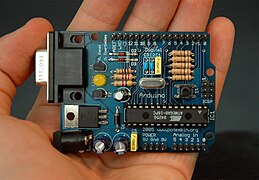
Arduino RS232[38]
(male pins) -
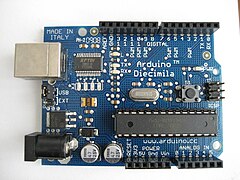
Arduino Diecimila[39]
-

Arduino Duemilanove[40]
(rev 2009b) -

-

-

Arduino Leonardo[44]
-

Arduino pro micro (AtMega32U4)
-
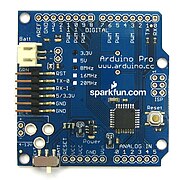
Arduino Pro[45]
(No USB) -

Arduino Mega[46]
-
Arduino Nano[47]
(DIP-30 footprint) -

Arduino LilyPad 00[48]
(rev 2007) (No USB) -

Arduino Robot[49]
-

Arduino Esplora[50]
-

Arduino Ethernet[51]
(AVR + W5100) -

Arduino Yún[52]
(AVR + AR9331)
Shields [edit]
Arduino and Arduino-compatible boards use printed circuit expansion boards chosen shields, which plug into the usually supplied Arduino pin headers.[54] Shields can provide motor controls for 3D printing and other applications, GNSS (satellite navigation), Ethernet, liquid crystal display (LCD), or breadboarding (prototyping). Several shields can also be made practise it yourself (DIY).[55] [56] [57]
-

Some shields offer stacking headers which allows multiple shields to be stacked on height of an Arduino board. Here, a prototyping shield is stacked on two Adafruit motor shield V2s.
-
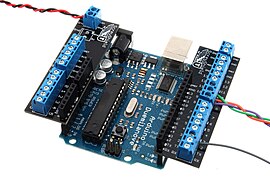
Spiral-terminal breakout shield in a fly-type format, assuasive blank-finish wires to be connected to the board without requiring whatever specialized pins.
-
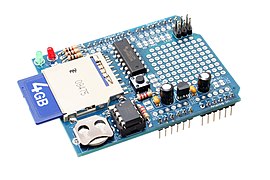
Adafruit Datalogging Shield with a Secure Digital (SD) carte du jour slot and real-fourth dimension clock (RTC) chip along with some infinite for calculation components and modules for customization.
-

Adafruit Motor Shield with screw terminals for connection to motors. Officially discontinued, this shield may still be available through unofficial channels.
-
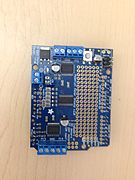
The Adafruit motor shield V2 uses IiiC, requiring vastly fewer digital I/O pins than attaching each motor straight.
-
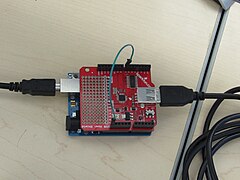
A USB host shield which allows an Arduino board to communicate with a USB device such as a keyboard or a mouse.
Software [edit]
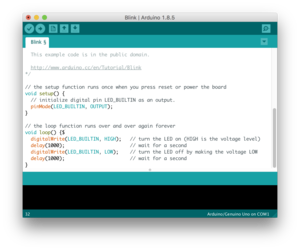 Screenshot of Arduino IDE showing Blink program | |
| Developer(southward) | Arduino Software |
|---|---|
| Stable release | i.8.xvi / six September 2021 (2021-09-06) [58] |
| Written in | Java, C, C++ |
| Operating arrangement | Windows, macOS, Linux |
| Platform | IA-32, x86-64, ARM |
| Type | Integrated evolution environment |
| License | LGPL or GPL license |
| Website | www |
A program for Arduino hardware may be written in whatsoever programming language with compilers that produce binary automobile code for the target processor. Atmel provides a development environment for their 8-bit AVR and 32-bit ARM Cortex-One thousand based microcontrollers: AVR Studio (older) and Atmel Studio (newer).[59] [60] [61]
IDE [edit]
The Arduino integrated evolution environment (IDE) is a cross-platform application (for Microsoft Windows, macOS, and Linux) that is written in the Coffee programming language. Information technology originated from the IDE for the languages Processing and Wiring. It includes a code editor with features such every bit text cutting and pasting, searching and replacing text, automatic indenting, brace matching, and syntax highlighting, and provides simple 1-click mechanisms to compile and upload programs to an Arduino board. It likewise contains a bulletin area, a text console, a toolbar with buttons for common functions and a hierarchy of operation menus. The source code for the IDE is released under the GNU General Public License, version 2.[62]
The Arduino IDE supports the languages C and C++ using special rules of lawmaking structuring. The Arduino IDE supplies a software library from the Wiring projection, which provides many common input and output procedures. User-written lawmaking simply requires two basic functions, for starting the sketch and the main program loop, that are compiled and linked with a programme stub principal() into an executable cyclic executive plan with the GNU toolchain, besides included with the IDE distribution. The Arduino IDE employs the program avrdude to convert the executable code into a text file in hexadecimal encoding that is loaded into the Arduino board by a loader program in the board'southward firmware.
From version 1.8.12, Arduino IDE windows compiler supports simply Windows vii or newer Os. On Windows Vista or older 1 gets "Unrecognized Win32 application" mistake when trying to verify/upload programme. To run IDE on older machines, users tin either use version ane.8.eleven, or copy "arduino-builder" executable from version 11 to their current install binder as its independet from IDE. [63]
IDE 2.0 [edit]
On October xviii, 2019, Arduino Pro IDE (alpha preview) was released. After, on March 1, 2021, the beta preview was released, renamed IDE ii.0. The arrangement still uses Arduino CLI (Command Line Interface), but improvements include a more professional development environment, autocompletion support, and Git integration.[64] The awarding frontend is based on the Eclipse Theia Open Source IDE. The main features available in the new release are:[65]
- Modern, fully featured development environs
- Dual Mode, Archetype Mode (identical to the Classic Arduino IDE) and Pro Style (File System view)
- New Board Manager
- New Library Director
- Board List
- Basic Motorcar-Completion (Arm targets just)
- Git Integration
- Series Monitor
- Dark Fashion
Sketch [edit]
A sketch is a programme written with the Arduino IDE.[66] Sketches are saved on the development computer as text files with the file extension .ino. Arduino Software (IDE) pre-one.0 saved sketches with the extension .pde.
A minimal Arduino C/C++ program consists of only two functions:[67]
-
setup(): This function is called once when a sketch starts after power-up or reset. It is used to initialize variables, input and output pivot modes, and other libraries needed in the sketch. It is analogous to the partmain().[68] -
loop(): Subsequentlysetup()office exits (ends), theloop()role is executed repeatedly in the master program. It controls the lath until the board is powered off or is reset. It is analogous to the rolewhile(i).[69]
- Blink example

Power LED (ruddy) and User LED (dark-green) attached to pin 13 on an Arduino compatible lath
Most Arduino boards comprise a light-emitting diode (LED) and a electric current limiting resistor connected between pin 13 and ground, which is a convenient feature for many tests and program functions.[seventy] A typical program used by beginners, alike to Hi, World!, is "blink", which repeatedly blinks the on-board LED integrated into the Arduino lath. This program uses the functions pinMode(), digitalWrite(), and filibuster(), which are provided by the internal libraries included in the IDE environment.[71] [72] [73] This program is usually loaded into a new Arduino board by the manufacturer.
# define LED_PIN 13 // Pin number attached to LED. void setup () { pinMode ( LED_PIN , OUTPUT ); // Configure pivot 13 to be a digital output. } void loop () { digitalWrite ( LED_PIN , High ); // Turn on the LED. delay ( one thousand ); // Expect one 2nd (thousand milliseconds). digitalWrite ( LED_PIN , Low ); // Turn off the LED. filibuster ( g ); // Wait 1 second. } Libraries [edit]
The open up-source nature of the Arduino project has facilitated the publication of many free software libraries that other developers use to augment their projects.
Operating systems/threading [edit]
There is a Xinu Os port for the atmega328p (Arduino Uno and others with the same chip), which includes near of the basic features.[74] The source code of this version is freely available.[75]
In that location is also a threading tool, named Protothreads. Protothreads are described as "extremely lightweight stackless threads designed for severely memory constrained systems, such as small embedded systems or wireless sensor network nodes.[76]
Applications [edit]
- Arduboy, a handheld game console based on Arduino
- Arduinome, a MIDI controller device that mimics the Monome
- Ardupilot, drone software and hardware
- ArduSat, a cubesat based on Arduino.
- C-STEM Studio, a platform for hands-on integrated learning of calculating, science, engineering, technology, and mathematics (C-STEM) with robotics.
- Data loggers for scientific research.[77] [78] [79] [80]
- OBDuino, a trip computer that uses the on-board diagnostics interface institute in well-nigh modern cars
- OpenEVSE an open-source electrical vehicle charger
- XOD, a visual programming language for Arduino
- Tinkercad, an analog and digital simulator supporting Arduino Simulation
Recognitions [edit]
The Arduino project received an honorary mention in the Digital Communities category at the 2006 Prix Ars Electronica.[81]
The Arduino Engineering Kit won the Bett Award for "Higher Education or Further Teaching Digital Services" in 2020.[82]
Encounter also [edit]
- Listing of Arduino boards and uniform systems
- List of open-source hardware projects
Explanatory notes [edit]
- ^ Diecimila means "ten thousand" in Italian
- ^ Duemilanove ways "two thousand and ix" in Italian
- ^ Uno ways "1" in Italian
References [edit]
- ^ "Getting Started: FOUNDATION > Introduction". arduino.cc. Archived from the original on 2017-08-29. Retrieved 2017-05-23 .
- ^ a b c David Kushner (2011-10-26). "The Making of Arduino". IEEE Spectrum.
- ^ Justin Lahart (27 November 2009). "Taking an Open-Source Arroyo to Hardware". The Wall Street Journal . Retrieved 2014-09-07 .
- ^ a b Hernando Barragán (2016-01-01). "The Untold History of Arduino". arduinohistory.github.io . Retrieved 2016-03-06 .
- ^ "How many Arduinos are "in the wild?" About 300,000". Adafruit Industries. May xv, 2011. Retrieved 2013-05-26 .
- ^ "Arduino FAQ – With David Cuartielles". Malmö Academy. April 5, 2013. Archived from the original on 2017-09-06. Retrieved 2014-03-24 .
- ^ "Business Entity Summary for Arduino LLC". Mass.gov. Land of Massachusetts.
- ^ Allan, Alasdair (6 March 2015). "Arduino Wars: Group Splits, Competing Products Revealed?". makezine.com. Maker Media, Inc. Retrieved 21 Apr 2015.
- ^ Banzi, Massimo (19 March 2015). "Massimo Banzi: Fighting for Arduino". makezine.com. Maker Media, Inc. Retrieved 21 April 2015.
- ^ Williams, Elliot (28 March 2015). "Arduino SRL to Distributors: "We're the Existent Arduino"". Hackaday.com. Hackaday.com. Retrieved 21 Apr 2015.
- ^ "Arduino LLC vs Arduino SRL lawsuit; United States Courts Archive". Archived from the original on 2017-07-09. Retrieved 20 February 2018.
- ^ "Arduino Announces New Make, Genuino, Manufacturing Partnership with Adafruit". Make. sixteen May 2015. Retrieved 17 May 2015.
- ^ "Arduino Weblog – Two Arduinos become i". Arduino Blog. October 2016. Retrieved 2016-10-02 .
- ^ "Free Arduino | Make". Make: DIY Projects and Ideas for Makers. 2017-06-09. Retrieved 2017-12-22 .
- ^ "The Arduino Foundation: What's Upwardly?". Hackaday. 2017-06-nineteen. Retrieved 2017-12-22 .
- ^ "Arduino'due south New CEO, Federico Musto, May Have Fabricated His Academic Tape". WIRED . Retrieved 2017-12-22 .
- ^ Biggs, John. "CEO controversy mars Arduino's open time to come". TechCrunch . Retrieved 2017-12-22 .
- ^ "Arduino Blog – A new era for Arduino begins today". Arduino Blog. 28 July 2017. Retrieved 19 Jan 2018.
- ^ Tom Davis: BCMI Acquires Arduino AG and Makers Exhale a Sigh of Relief 31 July 2017 techwombat.com, accessed 29 Nov 2018
- ^ "Arduino reborn partners with ARM". Electronics Weekly. 2017-10-06. Retrieved 2017-11-03 .
- ^ Emilio, Maurizio Di Paolo (2020-02-04). "Open-source HW in the Mod Era: Interview of Arduino's CEO Fabio Violante". EE Times Europe . Retrieved 2020-06-23 .
- ^ "Announcing the Arduino Command Line Interface (CLI)". Arduino Web log. 2018-08-24. Retrieved 2020-06-23 .
- ^ "Announcing the Arduino IoT Cloud Public Beta". Arduino Blog. 2019-02-06. Retrieved 2020-06-23 .
- ^ https://content.arduino.cc/assets/UNO-TH_Rev3e-reference.zip[ bare URL ]
- ^ "Policy". Arduino.cc. Retrieved 2013-01-eighteen .
- ^ "Freeduino Open up Designs". Freeduino.org. Archived from the original on 2008-04-10. Retrieved 2008-03-03 .
- ^ "Hardware Index". Arduino Project. Retrieved 2013-12-10 .
- ^ "Fleck Hall of Fame: Atmel ATmega8". IEEE Spectrum: Technology, Engineering, and Science News . Retrieved 2017-10-ten .
- ^ "Arduino - Products". world wide web.arduino.cc . Retrieved 20 February 2018.
- ^ "Microcontroller Maniacs Rejoice: Arduino Finally Releases the 32-Chip Due". Wired . Retrieved 20 February 2018.
- ^ DI TORE, STEFANO, TODINO, MICHELE DOMENICO, PLUTINO, ANTONINA (2019). Le habiliment technologies due east la metafora dei sei cappelli per pensare a supporto del seamless learning. PROFESSIONALITÀ, vol. Numero 4/Two – 2019, p. 118-132, ISSN 0392-2790
- ^ "Optiboot Bootloader for Arduino and Atmel AVR". GitHub . Retrieved 2015-10-01 .
- ^ "Bare Basic Board (BBB) Kit". moderndevice.com . Retrieved 29 Nov 2018.
- ^ "DC Boarduino (Arduino compatible) Kit (w/ATmega328) - v1.0". adafruit.com . Retrieved 29 November 2018.
- ^ Di Tore S, TODINO M. D., Sibilio Due south (2019). Disuffo: Pattern, prototyping and development of an open-source educational robot . Course@RE, vol. 19, p. 106- 116, ISSN 1825-7321, doi: http://dx.doi.org/10.13128/formare-24446
- ^ "Redirect..." smartprj.com. Archived from the original on 2016-03-05. Retrieved 2011-05-03 .
- ^ Schmidt, Grand. ["Arduino: A Quick Get-go Guide"], Pragmatic Bookshelf, January 22, 2011, Pg. 201
- ^ "Arduino - ArduinoBoardSerial". world wide web.arduino.cc . Retrieved 20 February 2018.
- ^ "Arduino - ArduinoBoardDiecimila". www.arduino.cc . Retrieved 20 February 2018.
- ^ "Arduino - ArduinoBoardDuemilanove". www.arduino.cc . Retrieved twenty February 2018.
- ^ "Arduino Uno Rev3". www.arduino.cc . Retrieved xx February 2018.
- ^ Smith, (c) 2018, W.A. "Differences Between the Arduino Uno Revision two and Revision 3". startingelectronics.org . Retrieved twenty February 2018.
- ^ "Arduino - ArduinoBoardUnoSMD". www.arduino.cc . Retrieved 20 February 2018.
- ^ "Arduino Leonardo with Headers". www.arduino.cc . Retrieved 20 February 2018.
- ^ "Arduino Pro". world wide web.arduino.cc . Retrieved 20 Feb 2018.
- ^ "Arduino Mega official webpage (arduino.cc)". Retrieved 20 Feb 2018.
- ^ "Arduino Nano". www.arduino.cc . Retrieved twenty Feb 2018.
- ^ "LilyPad Arduino Main Board". world wide web.arduino.cc . Retrieved 20 February 2018.
- ^ "Arduino Robot". www.arduino.cc . Retrieved 20 February 2018.
- ^ "Arduino Esplora". www.arduino.cc . Retrieved twenty February 2018.
- ^ "Arduino Ethernet Rev3 without PoE". www.arduino.cc . Retrieved xx February 2018.
- ^ "Arduino Yún". www.arduino.cc . Retrieved twenty Feb 2018.
- ^ "Arduino Due". www.arduino.cc . Retrieved twenty Feb 2018.
- ^ "Arduino - ArduinoShields". www.arduino.cc . Retrieved 2017-10-04 .
- ^ "Arduino breadboard shield: $ten & 10 mins". todbot web log.
- ^ "Arduino Shields for Prototyping". tigoe.net.
- ^ Jonathan Oxer. "Arduino Shield list". Retrieved 5 Nov 2013.
- ^ "Arduino - ReleaseNotes". www.arduino.cc. Archived from the original on 3 May 2021. Retrieved 12 February 2020.
- ^ "Using Atmel Studio for Arduino evolution". Megunolink.com. Archived from the original on 2013-01-28. Retrieved 2013-01-18 .
- ^ "Using AVR Studio for Arduino evolution". Engblaze.com. Retrieved 2013-01-xviii .
- ^ "Ch Arduino". Retrieved 2016-ten-07 .
- ^ "arduino/Arduino". August 27, 2020 – via GitHub.
- ^ "arduino/Arduino". May 5, 2021 – via Arduino.cc.
- ^ Williams, Al (21 October 2019). "The Arduino IDE Finally Grows Up". Hackaday . Retrieved 26 October 2019.
- ^ "Introducing new Arduino Pro IDE with advanced features". Seed Studio. 21 October 2019. Retrieved 26 October 2019.
- ^ Programming Arduino Getting Started with Sketches. McGraw-Hill. Nov viii, 2011. ISBN978-0071784221.
- ^ "Arduino - BareMinimum". www.arduino.cc . Retrieved 20 February 2018.
- ^ "setup() - Arduino Reference". www.arduino.cc.
- ^ "loop() - Arduino Reference". www.arduino.cc.
- ^ "Blink Tutorial". Arduino.cc.
- ^ "pinMode() - Arduino Reference". www.arduino.cc.
- ^ "digitalWrite() - Arduino Reference". www.arduino.cc.
- ^ "filibuster() - Arduino Reference". world wide web.arduino.cc.
- ^ Xinu AVR version (Arduino)
- ^ Xinu avr atmega328p source code
- ^ Dunkels, A., Schmidt, O., and Voigt, T. (2005). Using Protothreads for Sensor Node Programming. Proceedings of the REALWSN 2005 Workshop on Existent-World Wireless Sensor Networks (2005). Presented at the REALWSN 2005 Workshop on Real-World Wireless Sensor Networks. Retrieved from http://urn.kb.se/resolve?urn=urn:nbn:se:mdh:diva-4058
- ^ Beddows, Patricia A.; Mallon, Edward K. (2018-02-09). "Cave Pearl Data Logger: A Flexible Arduino-Based Logging Platform for Long-Term Monitoring in Harsh Environments". Sensors. xviii (2): 530. Bibcode:2018Senso..18..530B. doi:x.3390/s18020530. PMC5856100. PMID 29425185.
- ^ Ali, Akram Syed; Zanzinger, Zachary; Debose, Deion; Stephens, Brent (2016-05-01). "Open Source Building Science Sensors (OSBSS): A low-price Arduino-based platform for long-term indoor ecology data collection". Edifice and Environment. 100: 114–126. doi:10.1016/j.buildenv.2016.02.010. ISSN 0360-1323.
- ^ Bardaji, Raul; Sánchez, Albert-Miquel; Simon, Carine; Wernand, Marcel R.; Piera, Jaume (2016-03-fifteen). "Estimating the Underwater Lengthened Attenuation Coefficient with a Low-Cost Instrument: The KdUINO DIY Buoy". Sensors. 16 (three): 373. Bibcode:2016Senso..xvi..373B. doi:10.3390/s16030373. PMC4813948. PMID 26999132.
- ^ Lockridge, Grant; Dzwonkowski, Brian; Nelson, Reid; Powers, Sean (2016-04-xiii). "Development of a Low-Cost Arduino-Based Sonde for Coastal Applications". Sensors. 16 (four): 528. Bibcode:2016Senso..sixteen..528L. doi:10.3390/s16040528. PMC4851042. PMID 27089337.
- ^ "Ars Electronica Archiv". Archived from the original on 2019-06-30. Retrieved 2015-03-27 .
- ^ "Arduino Education nominated for Bett Laurels". Arduino Blog. 2020-01-20. Retrieved 2020-07-01 .
Farther reading [edit]
- Massimo Banzi, Michael Shiloh; Make: Getting Started with Arduino; 3rd ed.; Make Community; 262 pages; 2014; ISBN 978-1449363338.
- Jeremy Blum; Exploring Arduino: Tools and Techniques for Applied science Wizardry; 2nd ed.; Wiley; 512 pages; 2019; ISBN 978-1119405375.
- John Boxall; Arduino Workshop: A Hands-On Introduction with 65 Projects; 1st ed.; No Starch Printing; 392 pages; 2013; ISBN 978-1593274481.
- Tero Karvinen, Kimmo Karvinen, Ville Valtokari; Brand: Sensors; 1st ed.; Make Community; 400 pages; 2014; ISBN 978-1449368104.
- Simon Monk; Programming Arduino Adjacent Steps: Going Further with Sketches; 2d ed.; McGraw-Hill Education; 320 pages; 2018; ISBN 978-1260143249.
- Simon Monk; Programming Arduino: Getting Started with Sketches; 2nd ed.; McGraw-Hill Education; 192 pages; 2016; ISBN 978-1259641633.
- John Nussey; Arduino For Dummies; 2nd ed.; John Wiley & Sons; 400 pages; 2018; ISBN 978-1119489542.
- Jack Purdum; Beginning C for Arduino: Learn C Programming for the Arduino; 2nd ed.; Apress; 388 pages; 2015; ISBN 978-1484209417.
- Maik Schmidt; Arduino: A Quick Start Guide; 2nd ed.; Pragmatic Bookshelf; Pragmatic Bookshelf; 323 pages; 2015; ISBN 978-1941222249.
External links [edit]
 | Wikimedia Commons has media related to Arduino. |
- Official website
- How Arduino is open up sourcing imagination, a TED talk by creator Massimo Banzi
- Evolution tree for Arduino
- Arduino Cheat Sheet
- Arduino Dimensions and Hole Patterns
- Arduino Shield Template
- Arduino Lath Pinout Diagrams: Due, Esplora, Leonardo, Mega, Micro, Mini, Pro Micro, Pro Mini, Uno, Yun
- Historical
- Arduino - The Documentary (2010): IMDb, Vimeo
- Massimo Banzi interviews: Triangulation 110, FLOSS 61
- Untold History of Arduino - Hernando Barragán
- Lawsuit documents from Arduino LLC vs. Arduino S.R.L. et al. - United States Courts Annal
Source: https://en.wikipedia.org/wiki/Arduino
0 Response to "Arduino - How to Read Uploaded Program"
Post a Comment